 Hideo Tanaka 13 min read
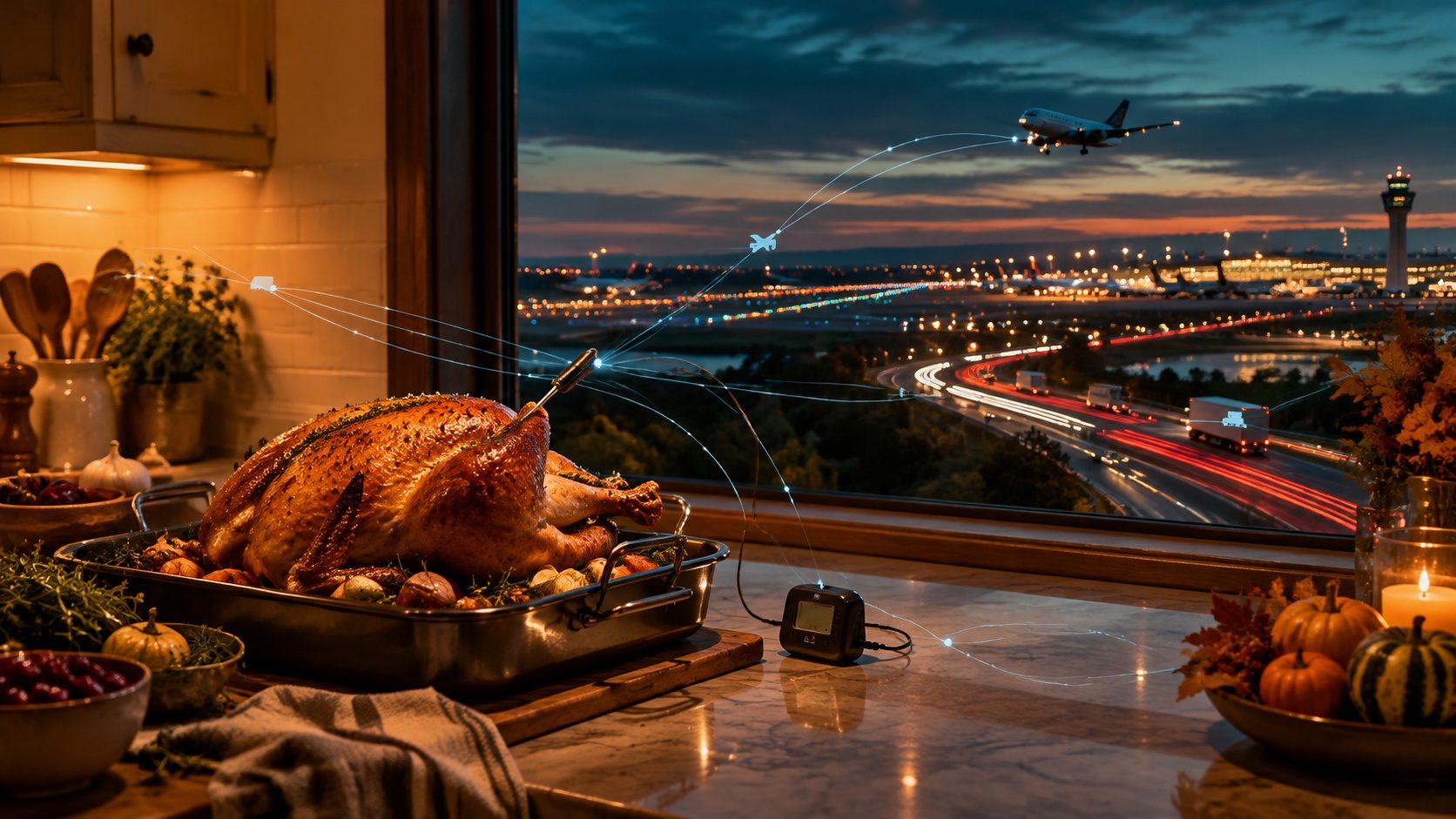
Happy Thanksgiving. On the surface, today is the least technical day of the American year: people travel home, cook one large meal and sit down together. Underneath, it is one of the most tightly coordinated events the country runs. Tens of millions of people move in the same few days. A single perishable product has to arrive, thawed, in tens of millions of kitchens at once. A parade of flying objects the size of buildings has to pass through a canyon of skyscrapers. And an army of people on telephones stands by to talk first-time cooks through it.
This piece looks at Thanksgiving the way an operations team would: as a set of systems, each with a history, a failure mode and a lesson. It is written on Thanksgiving Day 2026, when one of those systems has just made the news by doing exactly what it was designed to do.
Short version: The holiday you experience as tradition is held together by forecasting, surge capacity and human judgment. The best of its systems share one design choice: they automate the arithmetic and keep a person in charge of the decision.
Key takeaways
- A forecasting error built an industry. In 1953 Swanson was left with about 260 tons of unsold frozen turkey. The fix became the TV dinner.
- The return trip is the stress test. The busiest air-travel day in U.S. history was the Sunday after Thanksgiving 2025, with 3.13 million passengers screened.
- The turkey hotline is a 45-year lesson in support design. It added social media, texting and a voice assistant, and kept trained humans at the centre.
- Parade balloons are aircraft with rules. The 100th Macy’s parade was moved from today to Saturday because of forecast winds, the first weather postponement in its history.
- AI is useful in the kitchen for planning, not for sensing. A thermometer reading of 165°F is still the only thing that tells you a turkey is done.
System one: the surplus that became the TV dinner
Every supply chain has to guess demand, and Thanksgiving is the hardest guess in the American food calendar, because nearly all of it lands on one day. In 1953, according to Smithsonian Magazine, someone at C.A. Swanson & Sons badly overestimated how many turkeys the country would buy. The company was left with some 260 tons of frozen birds sitting in ten refrigerated railroad cars.
The story usually told is that a Swanson salesman, Gerry Thomas, borrowed an idea from the compartmented trays used for airline meals. He ordered 5,000 aluminium trays, and an assembly line filled them with turkey, cornbread dressing and gravy, peas and sweet potatoes. The product reached shops in 1954 in a box designed to look like a television set, and Smithsonian reports that Swanson sold around ten million of them in the first full year.
Two honest caveats belong here. First, Swanson did not invent the frozen meal. The Library of Congress traces complete frozen dinners back to Maxson Food Systems’ airline "Strato-Plates" in 1945 and to the Bernstein brothers’ Frozen Dinners, Inc. in Pittsburgh in 1949. Second, who inside Swanson deserves the credit is disputed. The Nebraska State Historical Society notes that former employees and members of the Swanson family have said the brothers and their staff developed the product together. What nobody disputes is that Swanson was the first to mass-market it and coined the name.
The systems lesson: excess inventory is only waste if the packaging stays the same. Swanson’s real innovation was not freezing food. It was reframing a surplus as a new unit of sale and attaching it to the fastest-growing habit in the country, watching television.
System two: moving 81.5 million people
For this year’s holiday, AAA projects that 81.5 million Americans will travel at least 50 miles from home between Tuesday 24 November and Monday 30 November. That is fractionally below last year’s 81.6 million and ends a three-year run of records. The Transportation Security Administration expects to screen about 17.6 million air passengers over the same seven days, with more than three million on Sunday 29 November alone.
That Sunday matters. The outbound journey is spread across several days, because people leave whenever work and school allow. The return is compressed, because almost everyone needs to be back by Monday morning. The result is a predictable annual spike. On the Sunday after Thanksgiving 2025 the TSA screened 3.13 million people, which Reuters reported as the highest single-day total in the agency’s history. The same report notes that before 2024 the agency had passed three million in a day only twice; in 2025 it happened on eight separate days.
| Measure | Figure | Source |
|---|---|---|
| People travelling 50+ miles, 24 to 30 Nov 2026 | 81.5 million (forecast) | AAA |
| Change from 2025 | Down 0.1%, about 121,000 fewer travellers | AAA |
| Air passengers screened, 24 to 30 Nov 2026 | About 17.6 million (forecast) | TSA |
| Expected peak day in 2026 | Sunday 29 Nov, more than 3 million | TSA |
| Busiest day on record | Sunday 30 Nov 2025, 3.13 million | TSA, via Reuters |
| Flights forecast over nine days in 2025 | More than 360,000, the most in 15 years | FAA, via Reuters |
The systems lesson: capacity has to be planned for the peak, not the average, and the peak is on the way back. This year the East Coast storm adds a second variable. New York City’s emergency managers have advised people to avoid travel on Thursday afternoon and evening if they can, which will push still more journeys toward the weekend.
System three: the hotline that kept its humans
In November 1981 the turkey producer Butterball opened a toll-free telephone line with one job: to answer cooking questions. According to the company’s own history, six home economists took about 11,000 calls in that first season. WIRED has traced what came next: social media in 2008, texting in 2016, and in 2018 a cloud-based call system and a skill for Amazon’s Alexa voice assistant. Axios reported this month that the line, based in Naperville, Illinois, is now in its 45th year, runs from early November to Christmas Eve, and is staffed by people with food-related degrees or training, including chefs, dietitians and food scientists.
Notice what did not change. Each new channel was added alongside the phone call rather than replacing it. An MIT Sloan marketing lecturer has described the line as a model of how to build a relationship by giving people something valuable instead of a sales pitch. From an engineering point of view it is also a model of escalation design. The simple, repeatable questions can go to an automated channel. The panicked ones, where a bird is still frozen at ten in the morning and eleven guests are on the way, go to a person who can ask follow-up questions and calm someone down.
There is a public counterpart. The U.S. Department of Agriculture’s Meat and Poultry Hotline is staffed by food-safety specialists, including on Thanksgiving Day itself, and the USDA says the week before the holiday is its busiest of the year. Its most common question is how to thaw a turkey, and the answer is pure scheduling arithmetic: in a refrigerator, allow 24 hours for every four to five pounds.
| Turkey weight | Time to thaw | Start by, for a Thursday meal |
|---|---|---|
| 8 to 12 pounds | 2 to 3 days | Monday |
| 12 to 16 pounds | 3 to 4 days | Sunday |
| 16 to 20 pounds | 4 to 5 days | Saturday |
| 20 to 24 pounds | 5 to 6 days | Friday |
If the refrigerator deadline has passed, the USDA’s cold-water method is the fallback: keep the bird in its wrapper, submerge it in cold tap water and change the water every 30 minutes, then cook it immediately. Thawing on the counter, or in a cold garage, is not safe. The USDA calls the garage idea the most common misconception its callers share.
System four: flying buildings down a city street
The Macy’s parade began in 1924 with floats, bands and animals borrowed from the Central Park Zoo. Balloons arrived in 1927, starting with Felix the Cat, and the early years are a case study in learning by incident. The Library of Congress records that the first balloons had no way to be deflated, so they were simply released and burst as they rose. The next year they were fitted with slow-release valves and return-address labels offering a reward. Some came down in the East River or drifted out to sea, and in 1932 one wrapped around the wing of an aeroplane and sent it into a tailspin. Releases stopped.
Today the giant balloons are designed and built in-house at a Macy’s studio in Moonachie, New Jersey. Popular Science has described the method: a new character is first sculpted in clay, and the designers work out how much lifting gas it will need by measuring how much water the model displaces. An average balloon takes around 12,000 cubic feet of helium. The Smithsonian’s National Air and Space Museum treats them, reasonably, as part of the history of flight.
They also fly under rules. After a balloon struck a lamppost in high winds in 1997 and injured spectators, a mayoral task force reviewed the parade and New York City adopted wind limits: the giant balloons do not fly if sustained winds exceed 23 miles per hour or gusts exceed 34. Handlers are trained in advance, and the balloons are flown lower as the wind rises.
Which brings us to today. This year’s parade is the 100th, and for the first time in its history it has been postponed for weather. With a coastal storm forecast to bring sustained winds of 30 to 40 miles per hour and gusts up to 65 to New York on Thanksgiving afternoon, the city, Macy’s and the broadcaster announced on Wednesday that the parade will run on Saturday 28 November at 8:30 a.m. Eastern instead. The only previous breaks were the wartime cancellations of 1942 to 1944. The parade’s executive producer said the balloons already in Manhattan would be taken back to New Jersey and made ready again, a job that normally takes weeks, in about 24 hours.
The systems lesson: a safety limit only works if someone is willing to act on it when it is expensive. A threshold written after an accident in 1997 has just moved a centenary broadcast by two days. That is what a working rule looks like.
System five: a shopping season built on purpose
The commercial side of the weekend was designed too, one piece at a time. The 1924 parade was created to draw crowds to a newly enlarged department store and open the Christmas shopping season. In 1939 President Franklin Roosevelt went further and moved the holiday itself a week earlier to give retailers more selling days, a decision that the National Archives describes as causing two years of confusion before Congress fixed the date in 1941.
| Day | Named | Where the name came from |
|---|---|---|
| Black Friday | 1950s to 1960s | Philadelphia police slang for the traffic and crowds on the day after Thanksgiving |
| Cyber Monday | 2005 | Coined in a press release by Shop.org, the online arm of the National Retail Federation, on 28 November 2005 |
| Small Business Saturday | 2010 | Created by American Express as part of its Shop Small campaign |
| Giving Tuesday | 2012 | Launched by the 92nd Street Y in New York as a day for charitable giving |
The pattern is worth noticing. Black Friday is a name that grew from the ground up, as word historians have shown, and it started as a complaint. Every later name was written by an organisation and announced. Naming a day turned out to be a remarkably cheap way to create a deadline.
System six: where AI assistants help, and where they do not
A Thanksgiving dinner is a scheduling problem with one oven, several dishes with different temperatures and a fixed finish time. That is the kind of problem conversational AI tools handle well, and many cooks now use them. It helps to be clear about the boundary.
| Useful for | Not a substitute for |
|---|---|
| Working backwards from serving time to a minute-by-minute plan | A food thermometer. The USDA standard is 165°F in the thickest part of the breast, the innermost thigh and the innermost wing |
| Scaling a recipe from six people to fourteen and converting units | Your own senses. An assistant cannot smell, see or touch what is in your oven |
| Suggesting substitutions for a missing ingredient or an allergy | Official food-safety guidance. Check any time or temperature it gives you against the USDA |
| Spotting oven conflicts between dishes and proposing an order | A person who can ask you questions back when something has already gone wrong |
The reason for caution is simple. A language model produces an answer that sounds equally confident whether it is right or wrong, and a food-safety number is exactly the kind of detail where a small error matters. The sensible pattern is the one the hotlines arrived at decades ago: let the tool do the arithmetic and the organising, verify the safety-critical values against an authoritative source, and keep a human with real expertise one phone call away.
Seven things most people don’t know
- The TV dinner exists because of a bad sales forecast, and its first menu was a Thanksgiving meal.
- The box was the product. The first Swanson package was printed to look like a television set.
- The busiest flying day ever recorded in the United States was a Thanksgiving Sunday, 30 November 2025.
- Early parade balloons were released into the sky on purpose, with a reward for whoever found them.
- Balloon designers use water displacement, the method attributed to Archimedes, to work out how much helium a new character needs.
- "Black Friday" began as police slang, not a marketing slogan.
- The 100th parade is the first ever postponed for weather. It runs this Saturday.
Frequently asked questions
What is the busiest travel day of Thanksgiving week?
For air travel it is usually the Sunday after the holiday. The TSA’s single-day record of 3.13 million passengers was set on the Sunday after Thanksgiving 2025, and the agency expects more than three million again on Sunday 29 November 2026.
How long does a frozen turkey take to thaw?
In a refrigerator, the USDA says to allow 24 hours for every four to five pounds, so a 15-pound bird needs about three days. A fully thawed turkey can stay in the refrigerator for one or two more days before cooking.
Why was the 2026 Macy’s parade moved to Saturday?
A coastal storm was forecast to bring winds far above the limits at which the giant balloons are allowed to fly, along with heavy rain and coastal flooding. Organisers and the city moved the parade to Saturday 28 November for the safety of participants and spectators.
Can I rely on an AI assistant for cooking times?
Use it for planning and arithmetic, and confirm anything related to safety with the USDA or a thermometer. Doneness is a measurement, not an estimate: 165°F in three places.
A closing thought
It is easy to see systems as the opposite of warmth. Thanksgiving suggests otherwise. Behind the meal on your table are forecasters, drivers, air traffic controllers, security officers, food scientists, balloon handlers and people answering telephones on a holiday so that a stranger’s dinner turns out well. The machinery exists so that, for one afternoon, nobody has to think about it.
If you are travelling today, especially in the path of the storm, go carefully and give yourself time. To everyone working so that others can gather, thank you. Happy Thanksgiving, and may this be blessed for all.
Sources
- Smithsonian Magazine — How 260 Tons of Thanksgiving Leftovers Gave Birth to an Industry
- Library of Congress — Who "invented" the TV dinner?
- Nebraska State Historical Society — How a Nebraska company changed Americans’ eating habits
- AAA Newsroom — Thanksgiving Travel Expected to Dip Slightly Compared to Last Year (16 Nov 2026)
- TSA — TSA Is Ready for Thanksgiving Passenger Volumes (24 Nov 2026)
- Reuters — US screened record 3.13 million airline passengers on Sunday (1 Dec 2025)
- WIRED — The Butterball Turkey Talk-Line Gets New Trimmings (Nov 2018)
- MIT Sloan — The enduring business case for the Butterball Turkey Talk Line
- Axios Chicago — Butterball’s hotline has been saving the day for 45 years (20 Nov 2026)
- USDA — Thaw Your Turkey Safely in Time for Thanksgiving
- USDA Food Safety and Inspection Service — Let’s Talk Turkey: A Consumer Guide to Safely Roasting a Turkey
- Library of Congress — Macy’s Thanksgiving Parade, This Month in Business History
- Popular Science — The Science and Engineering of Macy’s Thanksgiving Day Balloons
- National Air and Space Museum — How Macy’s Thanksgiving Day Parade Balloons Are Made and Flown (25 Nov 2026)
- City of New York, Mayor’s Press Office — New Safety Measures for the 1998 Macy’s Thanksgiving Day Parade
- NBC News — Macy’s Thanksgiving Day Parade is pushed back to Saturday due to weather (25 Nov 2026)
- NYC Mayor’s Office — Travel Advisory for Thanksgiving Day as Coastal Storm Approaches (25 Nov 2026)
- National Archives, Prologue — Thanksgiving: Another FDR Experiment
- Wordorigins.org — Black Friday / Cyber Monday
- Quartz — How Cyber Monday, Small Business Saturday and Giving Tuesday got their names
From our own rounds
Measured on Agent Oracle, from real sessions people played on this site — not a third-party dataset.
- Rounds played here
- 27
- Questions per round
- 1
Subscribe to Agent Oracle updates
New articles, site messages and notifications — straight to your inbox. Unsubscribe anytime and your details are deleted.
Rate this article
Discussion
Comments are moderated. Read our editorial policy.